
Can You Put a Wood Burner in a Log Cabin, Yurt, Shepherd Hut or Garden Room?
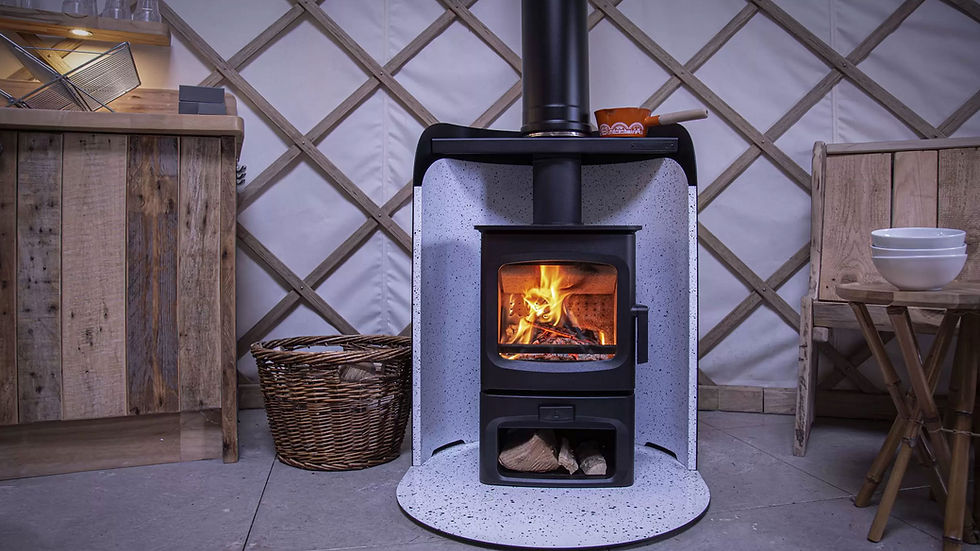
A wood-burning stove can completely transform a log cabin, yurt, shepherd hut, glamping pod, garden room or holiday let.
It brings warmth, atmosphere and year-round comfort - especially in outdoor leisure spaces where people want to create something cosy, memorable and inviting.
But one of the most common questions we are asked is:
Can you put a wood burner in a log cabin or garden room?
The answer is often yes - but it needs to be assessed, designed and installed correctly.
Installing a stove in a lightweight timber building, canvas structure or outdoor leisure space is very different from installing one in a traditional house. The appliance, hearth, flue, roof penetration, ventilation, carbon monoxide alarm and clearances to combustible materials all need careful consideration.
At Sussex Eco Solutions, we have worked with customers and companies around the UK to help supply and install stove solutions safely in cabins, yurts, shepherd huts, glamping accommodation, garden rooms and holiday-let settings.
Our HETAS-registered team can advise on the right approach before you buy a stove or flue kit.
Can you put a wood burner in a log cabin?
In many cases, yes, a wood burner can be installed in a log cabin.
However, log cabins are usually made from combustible materials. Timber walls, timber floors, timber roof structures, roof felt, insulation, internal linings and nearby furnishings all need careful consideration.
A stove installation in a log cabin should never be treated as a simple “stove and flue kit” job.
Before installation, the following need to be assessed:
Stove size and suitability
Hearth requirements
Heat shielding
Distance to combustible walls
Flue route
Roof or wall penetration
Ventilation
Carbon monoxide alarm location
Escape routes
Safe use and maintenance
HETAS guidance for leisure accommodation units specifically refers to log cabin accommodation units, yurts, shepherd huts, caravan holiday homes and residential park holiday homes. It covers solid fuel appliances up to 7kW and gives guidance around appliance selection, hearths, shielding, chimney/flue design, ventilation, CO alarms and commissioning.
Can you install a log burner in a garden room or garden office?
A log burner in a garden room or garden office may be possible, but it depends on the construction of the building.
Many modern garden rooms are compact, well insulated and built using timber frames, internal linings, insulation boards and roof membranes. That means two things are especially important.
First, the stove must not be too large for the space.
Second, the appliance and flue must be safely positioned away from combustible walls, ceilings, insulation and roof materials.
A stove that is too powerful can overheat a small garden office or garden room. It may also end up being run at a very low output for long periods, which is not ideal for efficiency, emissions or the condition of the flue.
This is why we normally recommend arranging a suitability survey before buying the stove.
What are the rules for wood burners in cabins, yurts and shepherd huts?
People often search for:
“wood burner in log cabin regulations”“rules for installing a log burner in a garden room”“do I need HETAS for a cabin stove?”“can I put a flue through a cabin roof?”
The key point is this: even where a leisure accommodation unit may not fall neatly into the same category as a normal house, the installation still needs to follow recognised safety principles.
That means considering:
Air supply for combustion
Safe discharge of flue gases
Carbon monoxide detection
Protection of the building from fire
Suitable information for future use and maintenance
The HETAS leisure accommodation guidance says installers should work in a way that is safe and meets the fundamental safety and efficiency requirements of Approved Document J where practical.
So while every cabin, yurt, shepherd hut, glamping pod or garden room needs to be assessed on its own merits, the installation should always be approached professionally.
Our experience with cabin, yurt and leisure accommodation stove projects
At Sussex Eco Solutions, we have supported a range of outdoor leisure and non-standard stove projects, including cabins, yurts, garden rooms, shepherd huts and holiday-style accommodation.
These projects often need more than just a stove.
They need a complete approach that considers the building, the people using it, and the long-term safety of the installation.
We can help with:
Stove selection
Stove and flue supply
Twin-wall flue design
Hearth and shielding advice
Roof and wall penetration guidance
Carbon monoxide alarm positioning
HETAS installation where applicable
Commissioning
Aftercare and maintenance advice
Holiday-let and guest-use considerations
For companies, glamping sites, retreat venues and holiday-let owners, we can also advise on multi-unit projects where several cabins, huts or accommodation units need assessing.
Do you need HETAS certification for a cabin stove?
Using a HETAS-registered installer is strongly advisable when installing a wood burner in a log cabin, garden room, holiday let, shepherd hut, yurt or glamping pod.
A HETAS-registered installer can assess whether the installation is suitable, carry out work within their registration scope, commission the appliance and provide appropriate certification where applicable.
This is particularly important if the building is used as:
A holiday let
Airbnb accommodation
Glamping accommodation
A guest cabin
A shepherd hut rental
A residential park or leisure unit
A commercial retreat or campsite setting
If an installation has already been carried out by someone else, it may not be possible simply to “sign it off” afterwards. In that situation, an inspection may identify remedial work before certification or further advice can be given.
What size stove do you need for a log cabin or garden room?
Small spaces usually need small stoves.
Bigger is not better.
A 5kW stove may be common in a house, but many cabins, yurts, shepherd huts and garden rooms need less heat than people expect.
HETAS guidance gives a general appliance sizing guide for leisure accommodation units, with approximate outputs based on room volume. For example, a space of up to 30m³ may only need around 3kW, while larger spaces may require more. The guidance covers appliances up to 7kW.
The right stove should be chosen based on:
Room volume
Insulation level
Intended use
Heat demand
Stove clearances
Flue route
Hearth and shielding requirements
Choosing the stove before the building has been assessed can lead to problems later.
Does the flue go through the roof or through the wall
One common question is whether the flue should go straight up through the roof or out through the wall.
In many cabin and garden room installations, a straight vertical flue through the roof is usually the preferred option where it can be done safely.
A straight flue generally gives better draw, fewer bends, easier sweeping and better performance. This is especially important in smaller leisure buildings, where the overall flue height may be shorter than in a conventional house.
HETAS guidance says chimney systems in leisure accommodation units are often lower in height, so the chimney should be kept as straight as possible and bends avoided where possible. It notes that this is best achieved using a top-flue outlet appliance with a straight chimney through the roof.
A wall exit can sometimes be used, but it needs careful design, correct bends, support, sweeping access and a safe route past combustible materials.
Can a flue go through a felt roof or timber roof?
This is one of the most important safety questions.
Many log cabins, garden rooms, yurts and glamping structures have roof coverings or roof structures that may be combustible or easily ignitable. These can include timber, felt, canvas, bitumen-based coverings, shingles, insulation, roof boards and internal linings.
The flue must maintain the correct distance from combustible materials, including the roof structure, insulation and headlining.
HETAS guidance also distinguishes between non-ignitable and ignitable roof surfaces when considering chimney termination height.
Where roof materials are combustible or uncertain, the installation should be treated with caution and assessed properly before any work is carried out.
Do you need heat shielding behind a wood burner in a cabin?
Often, yes.
Because cabins, garden rooms, shepherd huts and yurts are usually compact spaces, it may not be possible to achieve the stove manufacturer’s standard clearance distances to combustible walls.
In these cases, properly designed heat shielding may be required.
Heat shielding is not simply a decorative board behind the stove. It must be installed correctly, with suitable non-combustible materials, correct air gaps, appropriate fixings and enough space for airflow.
HETAS guidance for leisure accommodation units gives examples of shielding using metal heat shields and insulation board systems, including clearances, air gaps and sizing requirements.
In some situations, a purpose-designed product may help. For example, we supply the Charnwood Stove Pod, which is designed to create a protected setting around a stove and can be particularly useful where combustible walls, compact rooms or non-standard spaces need careful consideration.
You can view the Charnwood Stove Pod here.
Suitability still depends on the appliance, flue route, hearth, ventilation, clearances and the construction of the building, so it should always be assessed before purchase.
Do you need a carbon monoxide alarm?
Yes.
A suitable carbon monoxide alarm should be fitted where a solid fuel appliance is installed.
For leisure accommodation units, HETAS guidance refers to a CO alarm complying with BS EN 50291-2 and being permanently fixed between 1m and 3m from the appliance.
For holiday lets, glamping sites and guest accommodation, CO alarm checks should form part of the property’s regular safety routine.
Can you put a wood burner in a holiday let or glamping pod?
Yes, in many cases, but extra care is needed.
A stove in a holiday let, Airbnb, glamping pod, yurt or shepherd hut will often be used by guests who may not be familiar with wood burners.
That means the owner needs to think beyond the installation itself.
Important considerations include:
Safe stove installation
HETAS certification where applicable
Clear guest instructions
Regular chimney sweeping
Annual servicing/inspection
Carbon monoxide alarm checks
Smoke alarm checks
Fire-risk assessment
Insurance notification
Safe fuel storage
Keeping furnishings away from the stove and hearth
A stove can make a holiday property more attractive, but only if it is safe, well maintained and easy for guests to use correctly.
For holiday parks, glamping businesses, retreat venues and leisure accommodation operators, we can advise on single-unit or multi-unit projects.
Should you buy the stove before arranging a survey?
We would usually recommend arranging a survey before buying the stove or flue kit.
This is because the right appliance depends on the building.
Before choosing a stove, it is important to understand:
Whether there is enough space
Whether the stove clearances can be achieved
Whether heat shielding is needed
Whether the hearth can be installed safely
Whether the flue can pass safely through the roof or wall
Whether the roof covering creates additional risk
Whether ventilation is adequate
Whether the appliance output is suitable
Buying the wrong stove can make the installation more expensive, more complicated or sometimes unsuitable.
Wood burner installations for cabins, yurts and garden rooms across Sussex and the UK
Sussex Eco Solutions is based in Littlehampton, West Sussex, and we regularly advise customers across Sussex on wood burner installations for log cabins, garden rooms, outdoor offices, shepherd huts, yurts, glamping accommodation and holiday lets.
We have also worked with companies around the UK to help supply suitable stove and flue solutions for outdoor leisure spaces and non-standard buildings.
From coastal holiday lets near Littlehampton and Worthing to rural cabins, shepherd huts and glamping sites across the South Downs and beyond, we can help assess whether a stove is suitable for your space.
Our team can advise on:
Stove suitability
Appliance sizing
Hearth requirements
Heat shielding
Twin-wall flue design
Roof and wall penetrations
Carbon monoxide alarm positioning
Ventilation
Commissioning and certification
Holiday-let safety considerations
Product supply for projects outside our installation area
For projects further afield, we may be able to help with stove and flue supply, product advice, design considerations, and guidance for your local installer or project team.
Thinking about a wood burner for a cabin, yurt, shepherd hut or garden room?
A wood-burning stove can be a beautiful and practical addition to a cabin, yurt, shepherd hut, garden room, outdoor office, glamping pod or holiday let.
But it needs to be done properly.
The safest approach is to have the building assessed before choosing the stove or flue kit.
If you are considering a wood burner for your outdoor leisure space, contact Sussex Eco Solutions to arrange a suitability survey or discuss your project.
We can help you understand what is possible, what is safe and what needs to be considered before installation.


Comments